How does APRS work?
APRS is a broadcast network. A station transmits a packet over the air, and every receiver within range can receive and use it independently. There is no central node or mandatory route: a packet may remain local, be retransmitted by a digipeater, reach the Internet through an IGate—or do several of those things at once.
Station to station: APRS works over radio
The simplest case needs neither the Internet nor infrastructure. A mobile station transmits a packet and a home station receives it directly over RF.
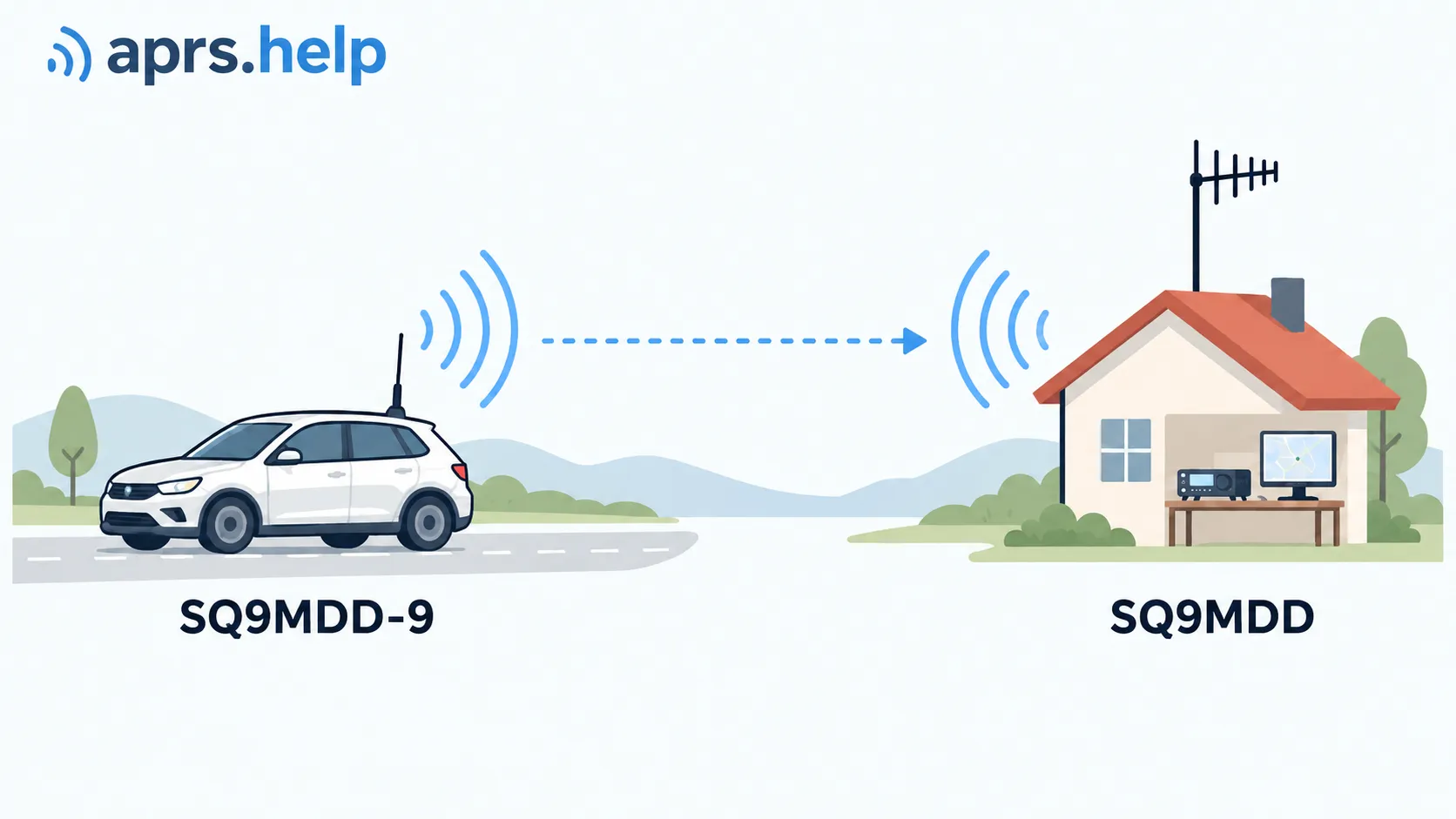
The received packet may contain, for example, a position, status, message, weather data, or telemetry. If the receiver understands its format, the information is immediately useful. That is a complete, correctly functioning APRS exchange.
Over radio, APRS data is usually carried in an AX.25 UI (Unnumbered Information) frame. Its text representation may look like this:
SQ9MDD-7>APRS,WIDE1-1:!5012.34N/01956.78E>The source callsign, destination address, path, and information field describe the frame and its APRS content. Later articles cover packet structure; here, the important question is what happens after transmission.
One transmission, many receivers
RF is a shared medium. The same transmission can be received simultaneously by a user station, a digipeater, and an IGate.
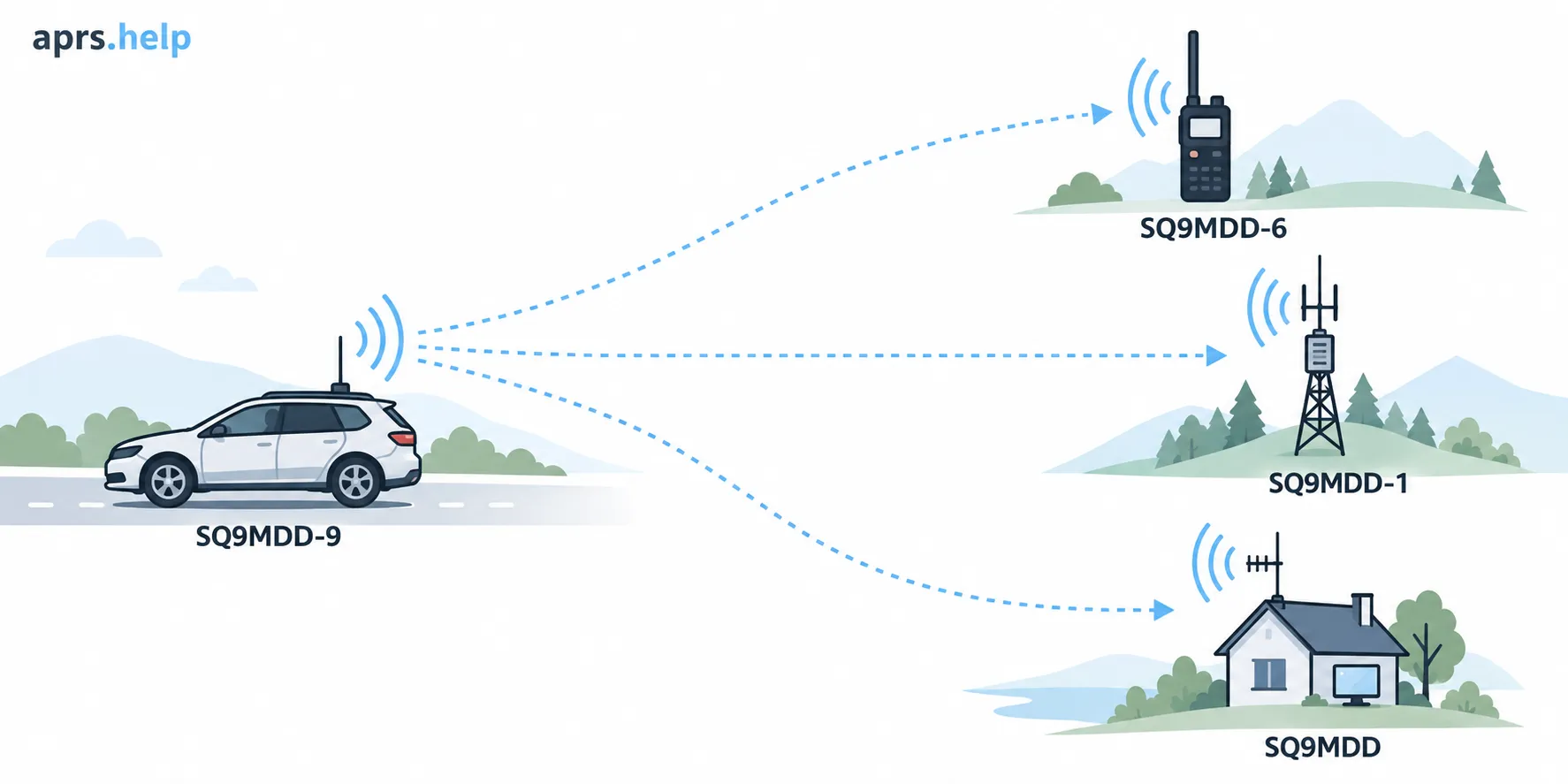
Reception does not create a queue or a forwarding chain. Each receiver makes its own decision: it displays the data, retransmits the packet over radio, or forwards it to APRS-IS. This is why multiple paths for the same information are normal in APRS.
Digipeater: extending RF coverage
A digipeater receives a radio packet and—when its path and configuration allow it—transmits it again. This lets the information reach beyond the direct range of the source station.
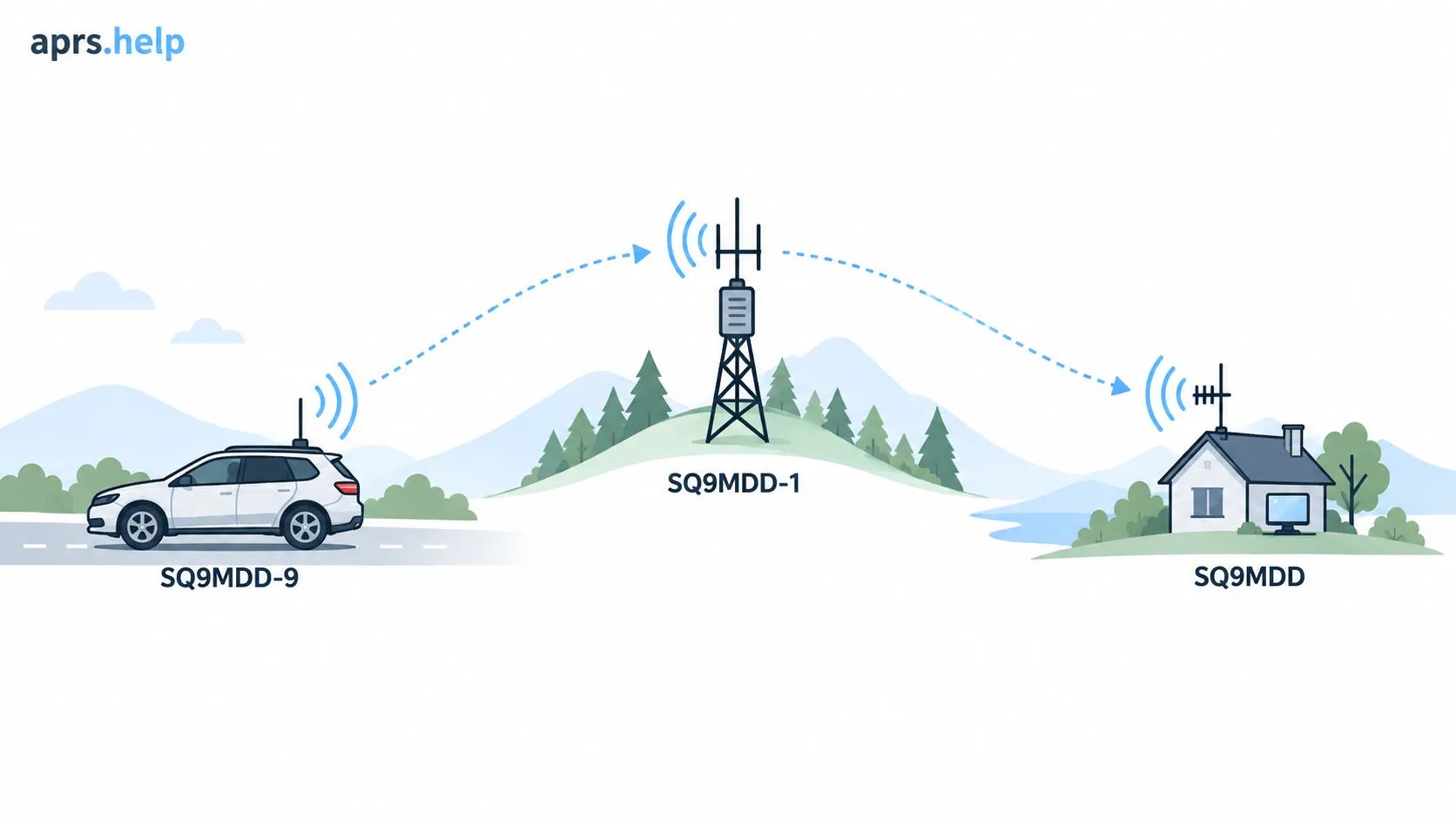
A digipeater should not repeat everything. Its decision depends, among other things, on the addresses in the path, the network’s local operating policy, and duplicate protection. Paths such as WIDE1-1 and WIDE2-n are commonly used; their semantics and configuration rules are covered separately.
The role of a digipeater can be summarized as:
RF → RFIt does not automatically imply Internet access.
IGate and APRS-IS: the RF–Internet boundary
An IGate (Internet Gateway) hears local RF traffic and forwards selected packets to APRS-IS, the global network of servers that distributes APRS data. This makes locally received packets available to applications, maps, and monitoring services.
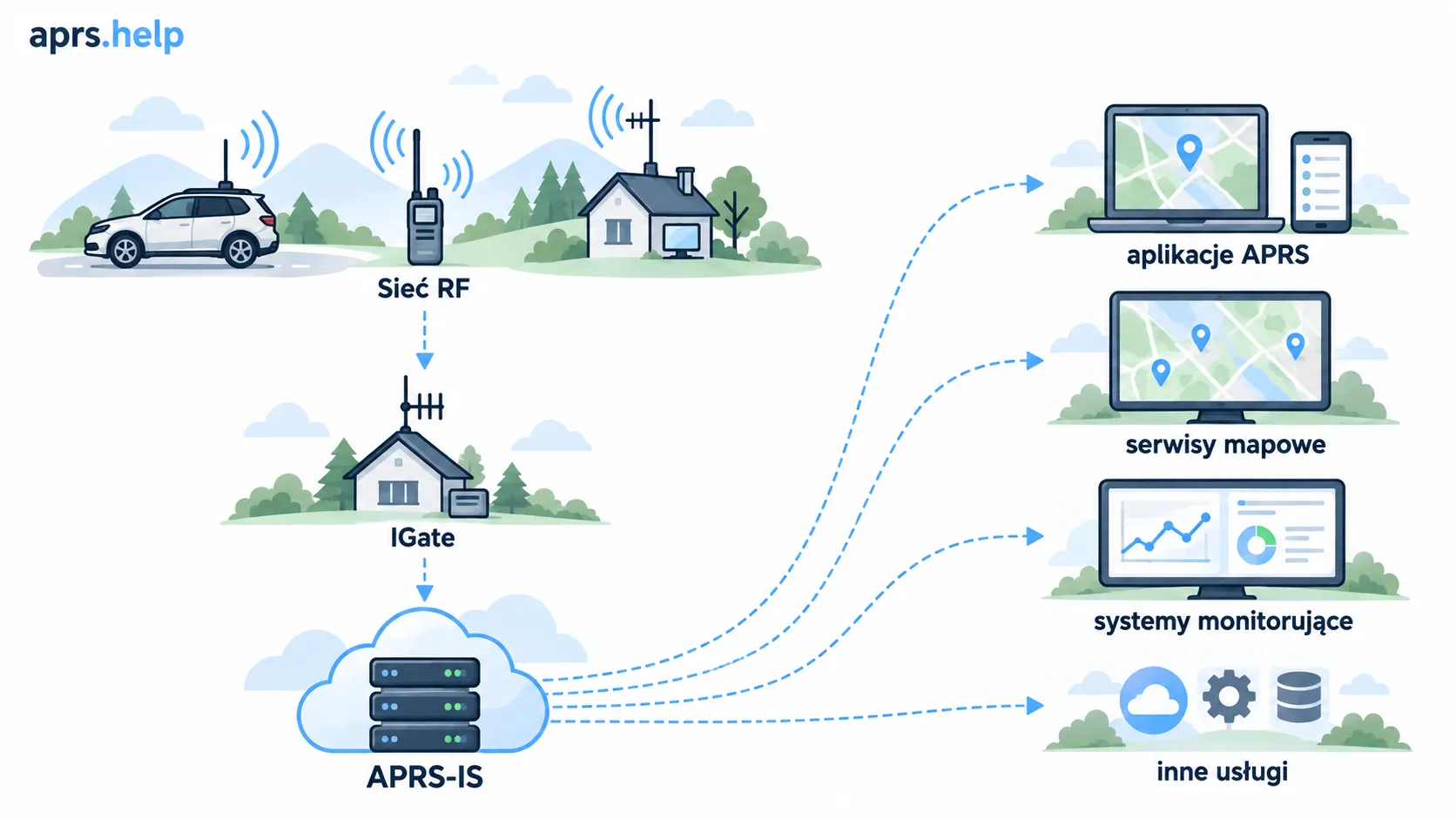
The primary direction of an IGate is:
RF → APRS-ISAn IGate can operate without digipeating, and a digipeater can operate without an IGate. A single station can of course perform both roles, but they are independent functions:
| Element | Role | Primary direction |
|---|---|---|
| Digipeater | Extends local radio-network coverage | RF → RF |
| IGate | Connects local RF to APRS-IS | RF → APRS-IS |
| APRS-IS | Distributes packets over the Internet | Internet |
APRS-IS extends the reach of information, but it does not replace the radio channel. A packet that does not appear on an Internet service may still have been received and used correctly locally.
Why the same frame appears more than once
In a real network, multiple IGates may hear the original transmission and its retransmission. Each can forward the frame to APRS-IS.
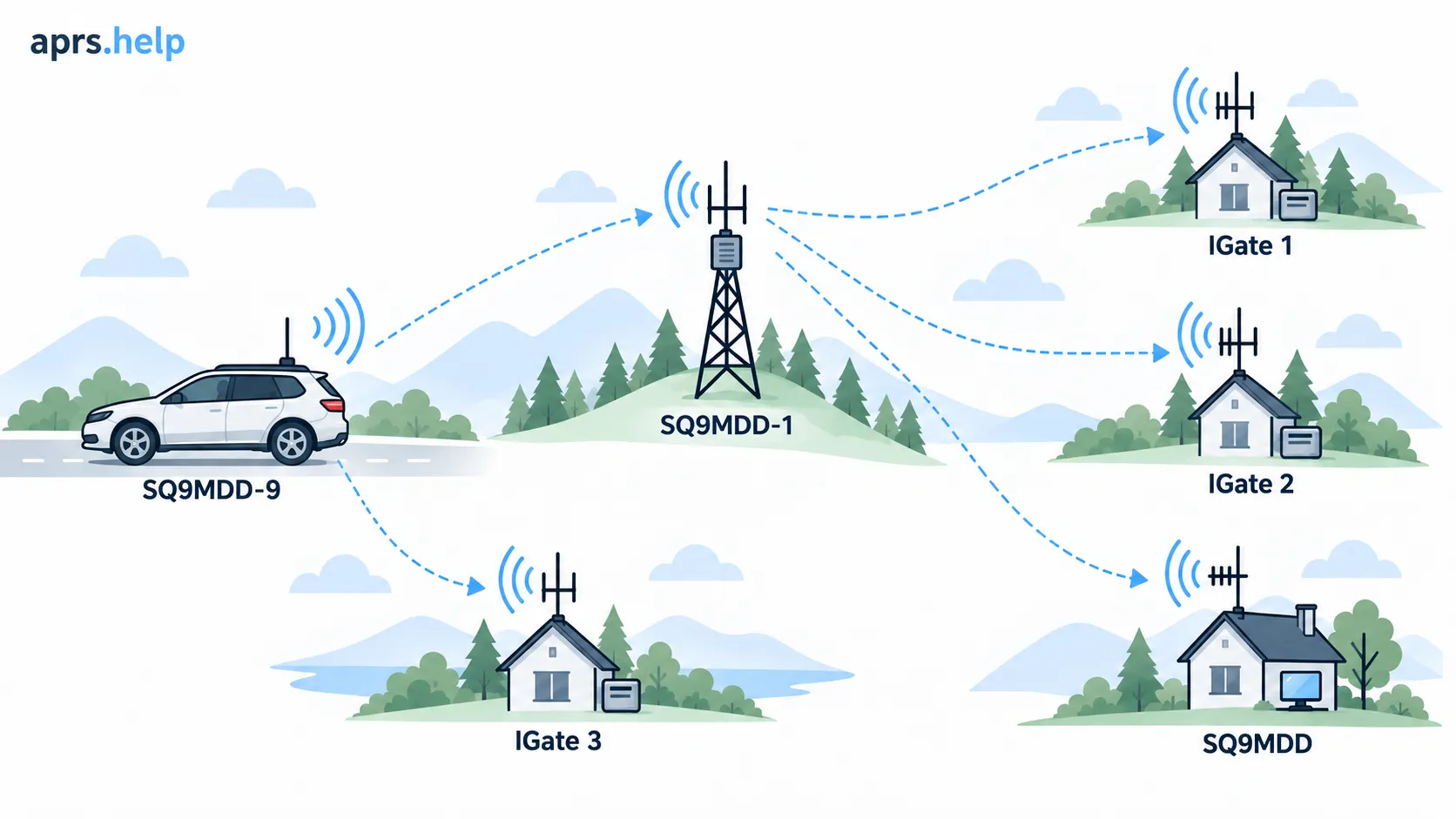
This is not a transmission error; it follows from the broadcast nature of RF. Digipeaters, IGates, and APRS-IS servers use duplicate recognition to avoid propagating the same frame further. Details depend on the implementation and configuration of each node.
From the Internet back to radio
The APRS-IS → RF direction is deliberately limited. The radio channel has low capacity and is shared by every station, so an IGate cannot treat it as a complete copy of APRS-IS.
A typical controlled case is a message addressed to a local station that the IGate has heard on RF recently. When selected traffic is sent from APRS-IS to radio, the third-party traffic mechanism can be used to preserve information about the packet’s origin. Gating rules, q-constructs, and the third-party traffic format deserve separate treatment.
The complete picture
The diagram below shows these roles working together. RF communication spreads locally; IGates move data between local radio and APRS-IS; applications and services use the data available on the Internet.
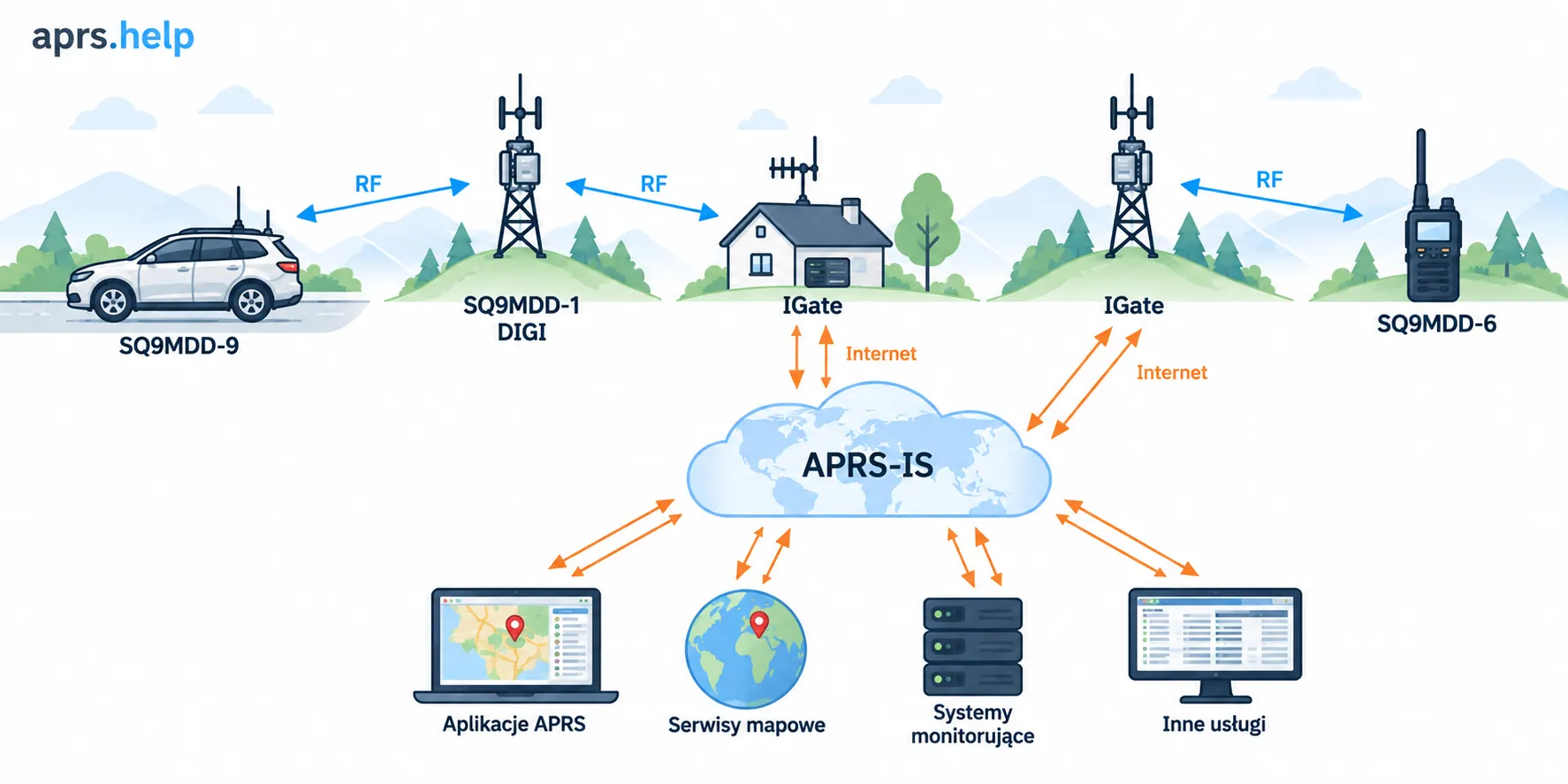
For one packet, three outcomes may therefore occur in parallel:
- local reception by other stations,
- extended coverage through digipeating,
- publication to APRS-IS through one or more IGates.
None is required for the others to occur. Local APRS can work without the Internet, and an IGate can forward a packet to APRS-IS without a digipeater.
Key points
- APRS is not a single route:
station → digipeater → IGate → Internet. - One RF transmission can be useful to many receivers and reach them by different paths.
- A digipeater retransmits radio traffic; an IGate connects RF with APRS-IS.
- Duplicates are natural in a broadcast network and are filtered by its components.
- The Internet improves the availability of data, but is not a condition for local APRS to work.
- Traffic from the Internet to RF must be selective so it does not burden the shared channel.
Next
The next step is to learn the structure of AX.25 frames and APRS packets, source addresses and SSIDs, the destination/TOCALL field, digipeater paths, and the differences between RF and APRS-IS traffic.